Nurse Who Writes

About
R.E. Hengsterman is a registered nurse, a Pushcart Prize-nominated, award-winning fiction and non-fiction writer, and an educator with over thirty years of healthcare experience. Coming from a place that combines the clinical and the imaginative, his writings have appeared in more than fifty publications, including Across The Margin, Maudlin House, Bluntly Magazine, Eunoia Review, Queen Mob’s Tea House, Barren Magazine, Riggwelter, Phenomenal Literature, Former Cactus, The Airgonaut and The Blotter Magazine.
As a writer that navigates the fine line between storytelling and science, he brings empathy to the facts and story to the data.
The Award-winning - The Shift Worker’s Paradox is a work of narrative nonfiction that mingles science, the life experiences of its author, and no-nonsense advice to investigate the less obvious expenses of life against the clock. Well-known for bridging the divide between healthcare and storytelling, his writing has helped to raise empathy and understanding in the clinical world. At Nurse Who Writes, he also works to merge science and narrative to clear up and calm the waters of healthcare, and enhance patient care, and also self-reflection for healthcare workers and writers alike.
Forthcoming in December 2026, The Deadly Wait takes readers inside America’s emergency departments to examine what happens when overcrowding, boarding, staffing shortages, and delayed care collide.
At the center of the book is a simple but urgent question: Is this patient safe to wait?
He holds a master’s degree in nursing education (MSN), Innovation, Leadership, and Entrepreneurship (M.E.), and the arts (MA). Inspired by Denis Johnson, Mohsin Hamid, and Alice Walker, his fiction aims for the heart, and his nonfiction works pursue mental clarity. He lives in North Carolina, splitting his time between research, storytelling and working the night shift.


The Deadly Wait
Preorder Now - Available 10 Dec 2026 - Everywhere Books are Sold
You go to the emergency department because you believe someone will help before it is too late. But what happens when the hospital is full, the waiting room is overflowing, nurses are stretched beyond safe limits, and the system can no longer reach every patient quickly enough? The Deadly Wait takes readers inside America’s emergency departments to examine one of the most troubling contradictions in modern medicine: a healthcare system built around the understanding that minutes save lives has normalized waits measured in hours. Through real patient stories, frontline experience, medical evidence, regulatory investigations, and an examination of the systems behind the waiting room, The Deadly Wait reveals how overcrowding, staffing shortages, hospital boarding, behavioral health failures, financial pressures, and limited capacity can transform delay into danger. This is not a book about blaming emergency physicians or nurses. It is about understanding what happens when extraordinary clinicians are asked to compensate for a system operating beyond its limits. The waiting room is not passive. A person who appeared stable an hour ago may not be stable now. And somewhere among dozens of people waiting may be someone whose physiology is unraveling faster than anyone realizes. The question is no longer simply, “How long have I been waiting?” It is: “Am I still safe to wait?” The Deadly Wait examines the promise at the heart of emergency medicine: that when catastrophe strikes, someone will be there to help. It asks whether America’s emergency departments can still keep that promise, and what patients, clinicians, healthcare leaders, and policymakers need to understand before the margin of safety disappears. If you enjoy reading about the systems shaping everyday life, The Deadly Wait combines the human storytelling of medical narrative nonfiction with an inside examination of one of the most consequential problems in American healthcare.


The Shift Worker's Paradox
Available Everywhere Books are Sold
“Working nights doesn’t just steal your sleep—it rewrites your biology.” Your body is hijacked by a different rhythm, and can be affected in various negative ways, when working night shifts. Well-known strategies for sleep, nutrition, and physical exercise won't cut it anymore, and won't shield you from the psychological toll of burnout, anxiety, and fatigue. To tackle these problems, tools and techniques in The Shift Worker’s Paradox are provided to help you correct them, and long-term protective protocols address heart health, hormone balance, and more. You can get ready for your next shift by implementing small, actionable hacks that prepare you to face the challenges of shift work. This book skillfully combines medical understanding, frontline narratives, and compassionate advice to offer more than just a survival strategy; it's a blueprint for reclaiming your health, performance, and overall happiness. If you've ever asked yourself, "How do I make this work without wearing myself out?", this book has your back. The value of your health shouldn't be the cost of your career. If you've ever dragged yourself to work exhausted, or fell apart due to sleepless nights and wonder how long you could keep going, this book will be your roadmap, showing you how to shield your mind, body and spirit, even when the schedule is stacked against you, and if you enjoy Why We Sleep by Matthew Walker you will also enjoy this book, which gives strategies that are specifically geared towards night workers, has a similar style to Breath by James Nestor or How to Change Your Mind by Michael Pollan, which are hard hitting, story-driven books that come with very practical advice. Coming home from a night shift is never pleasant, but The Shift Worker’s Paradox takes into account your reality as a nurse, a healthcare worker, or someone who works at night and provides actionable insights.




The Paper Boy & The Winter War
Thirty-Eight Stories of Flash Fiction
Available Everywhere Books are Sold
She rises, straddles his naked body, arms spread like wings. She lowers her mouth to his, releases the roach. It slides down his throat, its chitinous body lodging in his windpipe, wings unfurling. His breath rattles, then stops. Minutes later, the insect returns. She slips it inside herself, opening in pleasure, making a nest of her own. - The Nest She found comfort in the routine: staff bending his limbs against contractures, laying bony prominences on pillows as if into coffins. Pinned by the unknown, she sipped coffee in the still moments, watched long-timers clutch Bibles, watched newcomers beg for miracles. Sobriety brought memories back jagged: the unhappiness of her pregnancy, the infant who screamed himself blue, the marriage gone gray. - The Uknown

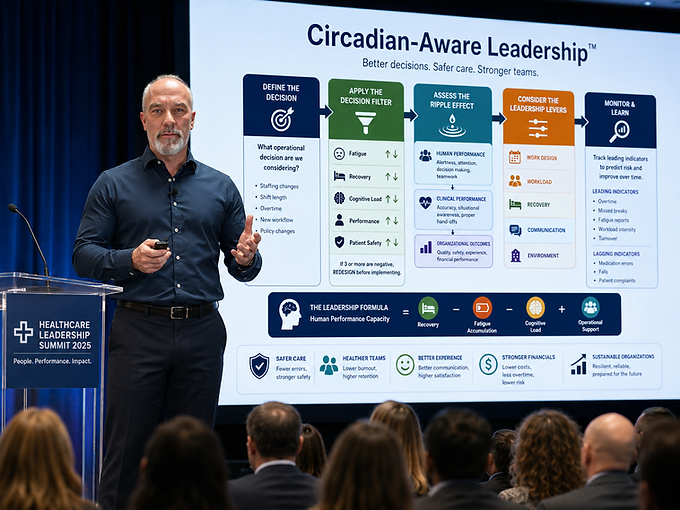
Speaking on Circadian-Aware Leadership™
Designing healthcare decisions around human biology, performance, and safety. Healthcare leaders make decisions every day that affect staffing, workload, recovery, patient safety, retention, and financial performance. Too often, those decisions are made through an operational lens alone. Circadian-Aware Leadership™ adds the missing layer: human biology. This speaking platform helps healthcare leaders understand how fatigue, recovery, cognitive load, and operational support shape human performance. The goal is not to ask clinicians to simply adapt to harder conditions. The goal is to help leaders design conditions where people can perform safely, consistently, and sustainably. The Core Message Before we ask, “Can our people adapt to this decision?” Circadian-Aware Leaders ask: “How can we design this decision to maximize human performance and patient safety?” Circadian-Aware Leadership™ reframes fatigue as more than a wellness issue. It is a leadership issue, a safety issue, a workforce issue, and an organizational performance issue. When fatigue rises, recovery shrinks, and cognitive load increases, performance changes. Communication changes. Decision-making changes. Risk changes. Leaders cannot control biology. But leaders can design the conditions where biology performs. Speaking Topics Circadian-Aware Leadership™: A New Model for Healthcare Decision-Making This keynote introduces the Circadian-Aware Leadership™ Decision Filter, a practical model for evaluating operational decisions through the lens of human performance, patient safety, and organizational outcomes. The session explores how staffing changes, shift length, mandatory overtime, workflow redesign, policy changes, and recovery time create ripple effects across clinical performance and patient care. Audience members will learn how to ask better leadership questions before implementing decisions that affect the people doing the work. Fatigue Is Not a Character Flaw Fatigue is often treated as an individual weakness. In healthcare, it is frequently normalized, minimized, or disguised as resilience. This session challenges that mindset. Participants will examine fatigue as a predictable biological response to workload, sleep disruption, cognitive demand, inadequate recovery, and circadian misalignment. The talk connects fatigue to clinical judgment, communication, medication safety, missed care, team performance, retention, and post-shift risk. This is not a lecture about working harder. It is a framework for leading smarter. The Ripple Effect of Leadership Decisions Every decision creates a ripple. A staffing change affects fatigue. Fatigue affects cognitive load. Cognitive load affects clinical performance. Clinical performance affects safety, experience, retention, and financial outcomes. This session helps leaders see beyond the immediate operational fix and recognize the downstream effects of decisions on people, teams, patients, and the organization. Recovery as a Leadership Strategy Recovery is often treated as personal responsibility. Circadian-Aware Leadership™ reframes recovery as an operational safety requirement. This session explores how shift design, time between shifts, breaks, vacation access, overtime patterns, and workload intensity shape the ability of healthcare workers to recover and return safely. The message is simple: a system that consumes recovery also consumes performance. Ideal Audiences This speaking platform is designed for healthcare organizations, nursing leaders, hospital executives, safety teams, quality leaders, educators, occupational health professionals, and workforce development teams. It is especially relevant for organizations struggling with burnout, turnover, staffing shortages, overtime dependence, patient safety concerns, workplace fatigue, or declining engagement. What Audiences Will Learn Participants will leave with a practical framework for evaluating decisions before they become safety risks. They will learn how to recognize fatigue accumulation, protect recovery, reduce unnecessary cognitive load, and identify leading indicators that predict downstream problems. They will also learn how to use leadership levers such as work design, workload management, communication, recovery protection, and environmental support to improve outcomes. Circadian-Aware Leadership™ helps organizations move toward: Safer care through fewer errors, stronger teamwork, and better decision-making. Healthier teams through lower burnout, better recovery, and improved retention. Better patient experience through more consistent communication and safer clinical performance. Stronger financial performance through reduced turnover, less overtime, lower risk, and more sustainable operations. More resilient organizations prepared for the future of healthcare work.
If you have questions about collaborations, interviews, speaking engagements, bulk orders, media requests, or professional partnerships connected to The Shift Worker’s Paradox, I welcome the conversation.