
What If Hospital Lighting Is Quietly Making Night Shift Nurses More Fatigued?


Most discussions about night-shift fatigue begin with the same advice: get more sleep, maintain good sleep hygiene, avoid caffeine before bed, and stick to a consistent routine. While those recommendations have merit, they often overlook a critical question.
What if the work environment itself is contributing to fatigue?
A new study published in Sleep suggests that one of the most overlooked tools for improving night-shift performance may be hanging directly above our heads: the lighting.
Researchers found that a carefully designed circadian-informed lighting strategy significantly improved vigilance, reduced attention failures, decreased subjective sleepiness, and increased daytime sleep following consecutive night shifts. Rather than simply making workers feel more awake, the lighting accelerated the body's adjustment to working at night by aligning light exposure with human circadian biology.
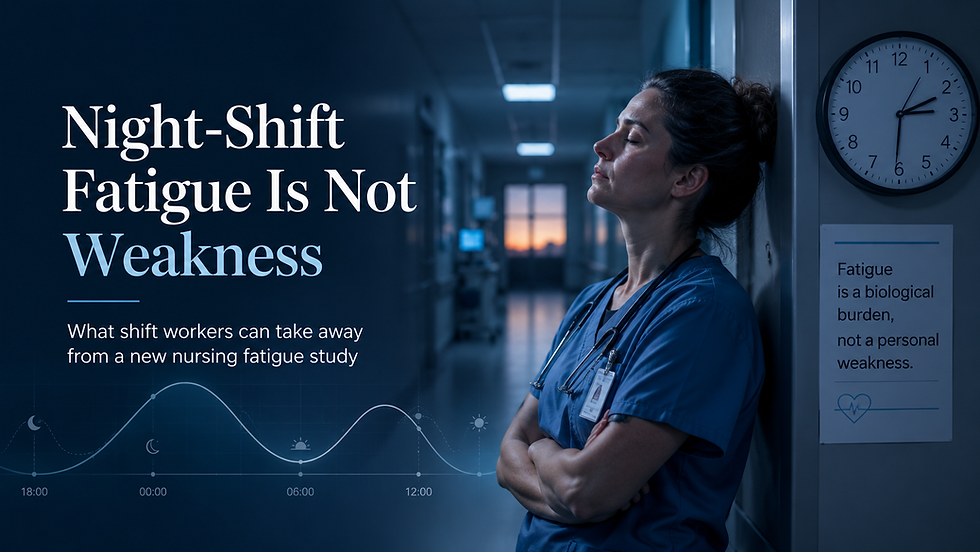
Fatigue Is More Than a Sleep Problem
Healthcare has traditionally approached fatigue as an individual responsibility. We encourage clinicians to sleep more, manage stress, exercise, and develop resilience. These strategies are important, but they address only part of the problem.
Human performance is heavily influenced by the environment.
The circadian system responds powerfully to light. Properly timed exposure to bright, blue-enriched light promotes alertness and helps delay the biological clock for night work, while dim, blue-depleted light minimizes unwanted circadian disruption. The researchers describe light as the strongest environmental cue for regulating the circadian timing system.
In other words, lighting is not simply about visibility—it is a physiological intervention.
What the Study Found
Using a randomized crossover design in a highly controlled sleep laboratory, investigators compared conventional dim lighting with an automated circadian-informed lighting schedule during a simulated four-night transition to night-shift work. Participants completed repeated cognitive testing while undergoing objective sleep measurements using polysomnography.
Compared with conventional lighting, circadian-informed lighting resulted in:
Approximately half as many attention lapses during psychomotor vigilance testing.
Faster reaction times and improved sustained attention.
Lower self-reported sleepiness during later night shifts.
Approximately 52 additional minutes of daytime sleep by the final sleep opportunity.
Better sleep efficiency and less time awake after falling asleep.
Much faster circadian adaptation to the night-shift schedule.
For healthcare professionals, sustained attention is not an abstract research outcome. It influences medication administration, clinical judgment, communication, and the ability to recognize subtle patient deterioration.
The Leadership Question
The most important message from this study is not that every hospital should install blue lights.
The intervention used in this research was carefully timed, automated, and adjusted throughout the shift schedule. Simply replacing existing fixtures with blue LEDs would not reproduce these results and could even be counterproductive if implemented incorrectly. Instead, the study invites healthcare leaders to ask a different question:
Are we designing work environments that support human physiology—or ignoring it?
Hospital leaders routinely invest in advanced technology, electronic health records, predictive analytics, and patient safety initiatives. Yet relatively little attention is given to environmental factors that directly influence human performance.
Lighting is one example. Scheduling practices, break opportunities, workload distribution, recovery time between shifts, and fatigue management policies are others.
A Systems Approach to Fatigue
Fatigue should not be viewed solely as an employee wellness issue. It is an operational risk.
Industries such as aviation, nuclear power, and defense increasingly rely on Fatigue Risk Management Systems (FRMS) that recognize fatigue as a systems problem requiring organizational controls.
Healthcare has been slower to adopt this perspective.
A modern FRMS evaluates workplace factors that influence fatigue rather than expecting individuals to overcome biology through determination alone. Circadian-informed lighting represents one environmental control that may reduce fatigue while improving both worker performance and safety.
The Future of Circadian-Aware Leadership™
This research also reinforces an emerging leadership principle: operational decisions should account for human physiology.
Before implementing changes, leaders should ask:
Will this increase or decrease fatigue?
Does it support recovery?
Will it improve sustained attention?
Does it reduce cognitive load?
Will it enhance patient safety?
These questions form the foundation of Circadian-Aware Leadership™—a leadership philosophy that recognizes organizational performance begins with human performance.
Hospitals cannot eliminate night work.
But they can begin designing systems that work with biology instead of against it.
That may prove to be one of the most important patient safety investments healthcare organizations make over the next decade.
Reference
Jay, S. M., et al. (2025). Circadian-informed overhead lighting improves cognitive performance and sleep during simulated night shift work. Sleep, 48(5). Oxford University Press. https://doi.org/10.1093/sleep/zsaf093
Author: R.E. Hengsterman, MSN, MA, M.E., RN
Registered nurse, night-shift administrator, and author of The Shift Worker’s Paradox
For educational purposes only. Not medical advice.
Editorial Standards
This article follows NurseWhoWrites editorial guidelines emphasizing evidence-based practice, transparent sourcing, and real-world clinical experience.


Comments