
What Shift Workers Can Take Away from This New Nursing Fatigue Study
- R.E. Hengsterman

- 5 days ago
- 5 min read
Article Reviewed: Night Shift and Occupational Fatigue Among Nurses Who Work 12 Hours in Jeddah
Authors: Bayan Alanmi, Ruba Alharazi, and Hayfa Almutary
Journal: Journal of Education and Health Promotion Publication Date: July 31, 2025
Volume/Article: 14:308 DOI: 10.4103/jehp.jehp_75_25 PMCID: PMC12413098 PMID: 40917955
Article Type: Scoping review
Focus: 12-hour night shifts, occupational fatigue, sleep disruption, mental health, cognitive performance, driving safety, burnout, and quality of life among nurses.
The Real Message: Fatigue Is Not a Character Flaw
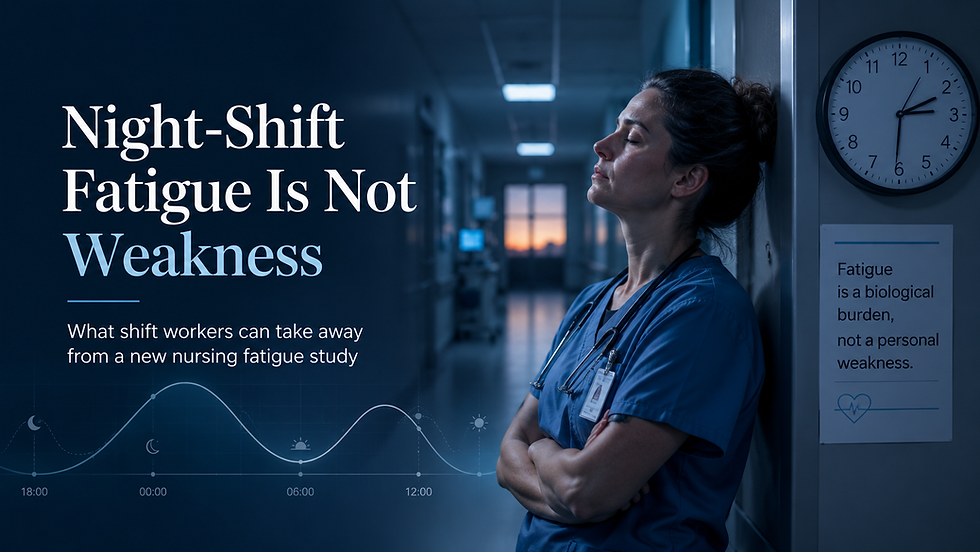
The most important takeaway from this article is simple: night-shift fatigue is not weakness. It is physiology under pressure.
This is also one of the central arguments highlighted in The Shift Worker’s Paradox: shift workers are not failing because they are tired; they are being asked to perform inside a schedule that works against human biology.
The review found that nurses working 12-hour night shifts face higher levels of occupational fatigue, sleep disturbance, anxiety, depression, burnout, impaired concentration, reduced motivation, and decreased physical performance. That should matter to every shift worker because it confirms what many already know but are rarely allowed to say out loud: the body pays a price for working against the clock.
Fatigue is often treated like a personal failure. Drink more coffee. Toughen up. Manage your time better. Push through.
But this article points in a different direction. The problem is not just the individual worker. The problem is the collision between 12-hour night shifts, disrupted circadian rhythm, high workload, inadequate recovery, and limited social support.
That is not a mindset problem. That is a systems problem.
Takeaway 1: Your Brain Is Not Fully Online After a Night Shift
One of the most practical findings involves cognition. The article connects night-shift fatigue with decreased concentration, impaired decision-making, slower response, and reduced work performance. For nurses, that affects patient care. For every shift worker, it affects driving, parenting, communication, judgment, and emotional control.
This matters most after the shift ends.
Many workers assume the danger ends when they clock out. In reality, that may be when the risk becomes most personal. The review discusses near-miss driving events and lane deviation after night shifts. That detail should stop every night-shift worker in their tracks.
Your shift is not over when you leave the unit, warehouse, plant, or station.
Your shift is over when you get home safely.
Takeaway 2: Recovery Time Is Not Optional
The review repeatedly points to inadequate recovery as a driver of occupational fatigue. Consecutive shifts, short recovery windows, and extended hours increase fatigue burden.
For shift workers, this means recovery has to become part of the job plan, not an afterthought.
That does not mean every worker can get perfect sleep. Many cannot. Families, second jobs, school schedules, commute distance, childcare, and financial pressure all interfere. But the principle still holds:
The less recovery you get between shifts, the more intentional your recovery strategy must become.
That may mean protecting the first 90 minutes after work, avoiding unnecessary errands after a night shift, using blackout curtains, planning food before fatigue hits, limiting caffeine late in the shift, or taking a short pause before driving home.
Small choices matter because fatigue stacks.
Takeaway 3: Night Shift Affects Mood, Not Just Energy
This article also reinforces a point that gets overlooked: night shift does not only make people tired. It can make people emotionally vulnerable.
The review links night-shift work with anxiety, depression, burnout, emotional fatigue, loneliness, stress, and reduced quality of life.
That should matter because many shift workers misread their own symptoms.
You may think you are becoming irritable, detached, unmotivated, or less patient because something is wrong with you. But chronic circadian disruption changes mood regulation. Poor sleep reduces emotional control. Isolation increases stress. Missed family time erodes connection.
The takeaway is not to excuse every reaction. The takeaway is to understand the terrain.
A tired brain is not a neutral brain.
Takeaway 4: Food, Sleep, and Caffeine Become Safety Tools
The article mentions that night work disrupts sleep, eating routines, diet patterns, and cognitive function. That is the foundation of a practical shift-worker strategy.
Food is not just food on night shift. It becomes a metabolic signal. Caffeine is not just caffeine. It becomes a timing decision. Sleep is not just rest. It becomes risk reduction.
For shift workers, the goal is not perfection. The goal is fewer biological insults stacked on top of the schedule.
A practical approach:
Avoid heavy meals close to your intended sleep window.
Use caffeine early in the shift, not near the end.
Eat lighter during the circadian low, especially between roughly 2 a.m. and 5 a.m.
Create a dark, cool, quiet sleep environment after work.
Treat post-shift driving as a high-risk task, not routine transportation.
Takeaway 5: Institutions Have Responsibility Too
The article concludes that policymakers should consider circadian rhythm-based interventions, including work duration, speed of shift change, number of consecutive shifts, and social support. That is one of its strongest points.
Shift workers should not carry this burden alone.
Hospitals and employers need to stop treating fatigue as an individual endurance test.
Scheduling design matters. Recovery time matters. Consecutive night shifts matter.
Workload matters. Staffing ratios matter. Commute safety matters.
System that depends on night workers have a duty to protect them.
That means fatigue education, safer scheduling, protected breaks, rest spaces, peer support, and honest conversations about post-shift driving risk. The worker has responsibility. But so does the system.
What the Article Does Not Fully Solve
This review confirms the problem, but it does not give shift workers a complete survival plan. Its recommendations are broad: better scheduling, social support, fatigue management, mental health resources, and more research.
Those are valid, but not enough. Shift workers need practical, real-world guidance that fits life after a 12-hour night shift. They need strategies for the drive home, the first meal after work, caffeine timing, sleep protection, family boundaries, recovery days, and emotional resilience. The article identifies the wound. The next step is building the protocol.
Final Takeaway
This article gives shift workers permission to take their fatigue seriously.
Not dramatically. Not helplessly. Seriously.
The science is clear: 12-hour night shifts can disrupt sleep, mood, metabolism, cognition, safety, and social life. That does not mean shift workers are broken. It means they are operating under biological strain.
The message is not, “You cannot survive night shift.” The message is sharper: You cannot survive it casually.
Shift work requires a system. A plan. A recovery strategy. A refusal to treat exhaustion as normal just because it is common. The body keeps score. The goal is to stop pretending it does not.


Comments